
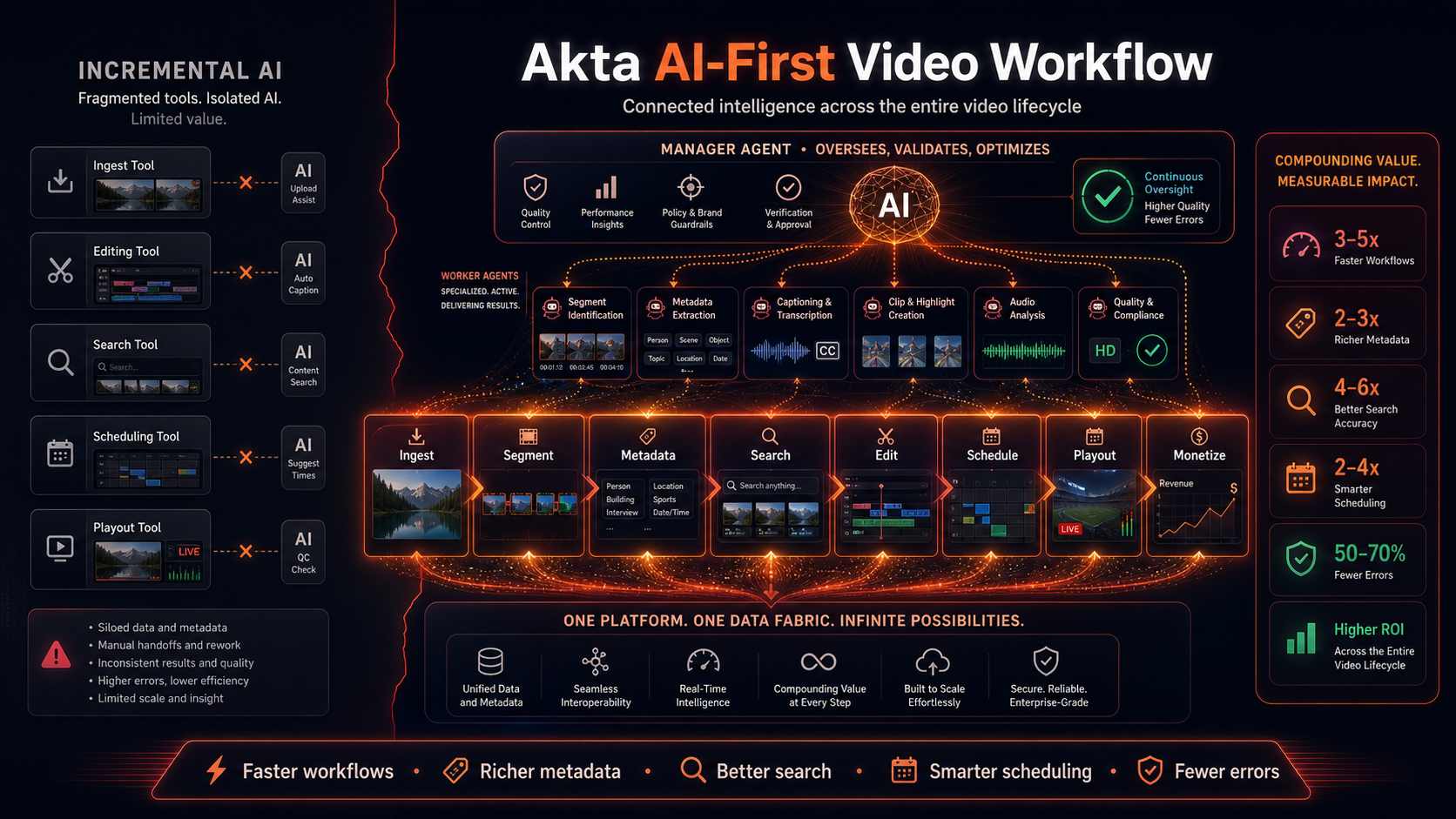
In media and entertainment, the conversation around AI is moving quickly. Every vendor now claims to have AI. Some are adding AI features to existing products. Some are embedding AI into isolated parts of the workflow. Some are using AI to automate small tasks that previously required manual effort.
But there is a major difference between adding AI to a product and building an AI-first video workflow.
That difference matters.
At Akta, we believe AI is not simply another feature category. It is a new operating model for video. When AI is embedded across the full workflow — from ingest and asset management to search, segmentation, metadata, editing, scheduling, playout, captions, translations, monitoring, monetization and optimization — the result is fundamentally different from a legacy system with a few AI enhancements added on top.
AI-first is not incremental improvement.
AI-first changes how video operations work.
The Problem with Incremental AI
Many video technology platforms were built for a different era. Their architectures were designed around manual workflows, rigid handoffs, siloed tools and human-driven decision-making. In that model, teams move content from one system to another, add metadata manually, search through archives by limited tags, create clips by hand, schedule channels with spreadsheets, monitor streams manually and troubleshoot issues after they occur.
Adding AI to one or two of those steps can help. But it does not transform the workflow.
That is the limitation of incremental AI.
A product may use AI to generate a transcript, but if that transcript does not inform search, clipping, scheduling, captions, translations, monetization and downstream publishing, its value is limited. A tool may use AI to identify a scene, but if that scene is not connected to metadata, rights, distribution rules, social packaging and channel assembly, the workflow still depends on manual coordination.
The fallibility of the incremental approach is that it treats AI like a point solution.
Video workflows do not operate as isolated points. They operate as connected systems.
The more components of the workflow that are AI-enabled, AI-aware and able to share intelligence with one another, the more powerful the entire operation becomes. In many cases, the improvement is not marginal. It can be orders of magnitude better than traditional processes because each AI-enabled step makes the next step smarter, faster and more accurate.
Why AI-First Workflows Compound Value
In an AI-first video workflow, every stage of the operation can contribute intelligence to the next.
A video is not just ingested. It is understood.
Scenes are not just detected. They are classified, described and made searchable.
Metadata is not just entered. It is generated, enriched and connected to the asset.
Captions are not just created. They can become part of search, translation, accessibility, compliance and content packaging.
Clips are not just cut. They can be recommended, titled, summarized and prepared for publishing.
Scheduling is not just a manual programming task. It can become an intelligent assembly process driven by content understanding, audience needs, rights, timing and monetization strategy.
This is where Akta’s AI-first approach matters.
Akta is building video workflows where AI is integrated into the core of the platform, not attached at the edges. That means AI can operate across the content lifecycle, connecting capabilities that are often separated in legacy environments.
The result is a platform designed to help media, entertainment and sports organizations create, transform and monetize more video with less manual work.
From Workflow Automation to AI-Powered Media Execution
Traditional workflow automation is rules-based. It is powerful, but limited. A workflow can be automated when the steps are known, the inputs are predictable and the output is clearly defined.
AI-powered media execution goes further.
It allows the platform to understand content, interpret context and assist with work that historically required trained operators, editors, producers or engineers.
For example, an AI-first platform can help identify important segments in a long-form video, extract useful metadata, generate summaries, create titles and descriptions, support faster editing, enable better search and help package content for multiple distribution endpoints.
In sports, that might mean identifying goals, saves, free kicks, interviews or key moments.
In news, it might mean finding storms, press conferences, breaking news segments or named individuals.
In entertainment, it might mean identifying car chases, dramatic scenes, cast appearances or thematic moments across a large archive.
The key is not that AI performs one task. The key is that AI improves the entire chain of work.
That is the difference between a product with AI and an AI-first video platform.
The Strategic Role of Agentic AI
Akta’s approach to agentic AI is especially important because media workflows require both speed and trust.
It is not enough for AI to move quickly. It must also produce work that is reliable, reviewable and usable in professional media environments.
That is why Akta’s vision for agentic AI is not simply “let the AI do the work.” It is a more thoughtful model: specialized AI agents perform specific tasks, and supervisory agents help evaluate, verify and improve the results.
Think of it as a worker-and-manager model for AI-powered video operations.
A “worker” agent may identify segments, generate metadata, create summaries, detect ad opportunities, produce captions or recommend clips.
Then a “manager” agent can come in behind that work to check quality, compare outputs, flag uncertainty, enforce rules, validate consistency and reduce errors before the result moves downstream.
This is a strategic and enlightened approach to AI because it recognizes the real-world needs of broadcasters, sports leagues and media companies. Efficiency matters. But quality, governance and confidence matter just as much.
Agentic AI should not simply accelerate mistakes.
It should help reduce them.
By designing systems where AI agents perform tasks and other AI agents validate the work, Akta is moving toward a model where workflows become faster, smarter and more dependable. The goal is not just automation. The goal is better execution with fewer manual touches and fewer errors.
Why This Matters for Media Companies
Media organizations are under pressure from every direction.
They need to publish more content across more platforms. They need to support live, VOD, FAST, OTT, social and broadcast workflows. They need to create clips faster. They need to improve monetization. They need to localize content. They need to manage large archives. They need to reduce operating costs. And they need to do all of this without adding complexity or headcount.
An incremental AI strategy cannot solve that challenge.
A point solution may improve one step, but it does not solve the larger operational problem.
Akta’s AI-first platform is designed for the larger reality of modern media operations: workflows are connected, content is fluid and speed matters at every stage.
When AI is built into the workflow itself, teams can move from reactive operations to intelligent execution.
That means faster turnaround, richer metadata, better discoverability, more efficient editing, smarter scheduling, improved accessibility, more scalable localization and stronger monetization opportunities.
It also means teams can unlock more value from content they already own.
AI-First Is the Competitive Advantage
The future of video workflow will not be defined by who has the longest list of AI features.
It will be defined by who has the smartest AI architecture.
Competitors that apply AI incrementally may deliver useful capabilities. But they are still operating from a legacy mindset: AI as an enhancement to existing workflows.
Akta is taking a different path.
Akta is building AI into the foundation of the video workflow, creating a platform where each AI-enabled component makes the next step more intelligent and more efficient. This is how media companies move beyond manual processes, beyond disconnected tools and beyond narrow automation.
AI-first is not about replacing creative and operational teams. It is about giving them leverage.
It is about helping teams do more with less manual work.
It is about turning large libraries into searchable, usable assets.
It is about transforming live and VOD workflows into intelligent content engines.
It is about using agentic AI not only to perform tasks, but to check, validate and improve the quality of the work.
That is why Akta’s role as an AI-first video workflow platform matters.
Because in the next era of media operations, the winners will not be the companies that simply add AI.
The winners will be the companies that are built for it.