
Vertical video isn’t a trend anymore — it’s the default
Open any major social app and you’ll see the same behavior: people don’t “watch a video,” they scroll a feed. Vertical, full-screen video has become the language of mobile attention.
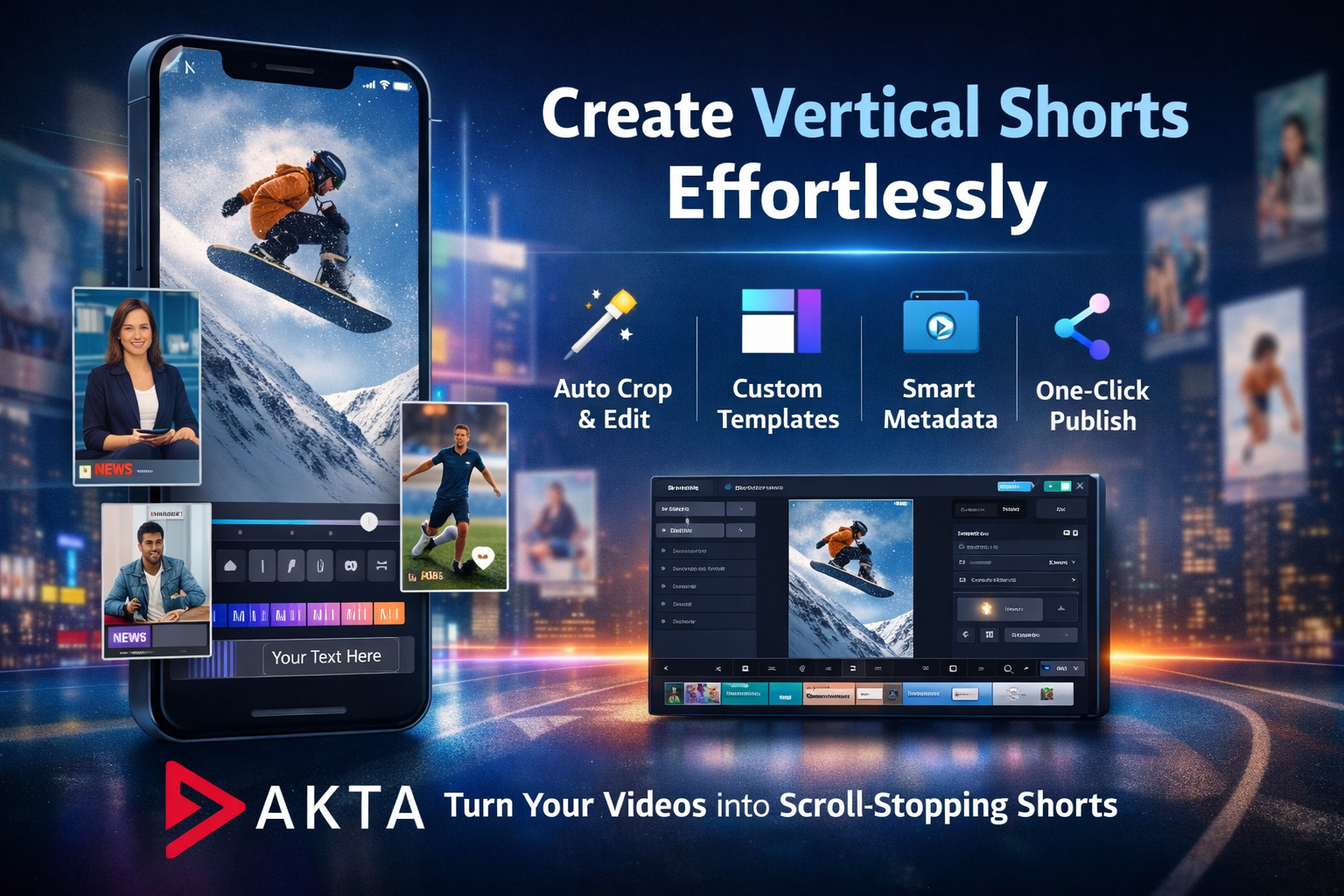
That behavior is now expanding beyond social. Publishers and media brands are bringing swipeable, social-like vertical experiences onto their own properties to increase engagement and time-on-site—without ripping and replacing their existing infrastructure. To address video publisher’s needs and to simplify the workflow, Akta recently launched a vertical video product positioned as a “simple way” to create interactive, swipeable experiences, implemented with a lightweight approach to speed time-to-value.
The takeaway is clear: vertical is now a primary surface, not a side experiment.
So the real question becomes:
Can your team produce vertical shorts without adding chaos?
Most organizations already have plenty of content that should become shorts:
- live sports moments
- news clips and interviews
- entertainment highlights
- product demos and explainers
- behind-the-scenes content
But turning “we have content” into “we have a reliable shorts pipeline” usually breaks down because:
- editors are stuck in manual, repetitive reformatting
- metadata and packaging don’t match downstream destinations
- teams can’t scale output without scaling headcount
- publishing becomes fragmented across tools, drives, and last-minute exports
Vertical video wins when it’s operationalized. That means workflow matters as much as format.
What “good” looks like: a vertical workflow that scales
A modern vertical workflow should be:
- Fast – create a short in minutes, not hours
- Repeatable – the process works the same way every time
- Brand-safe – templates, rules, and controls prevent weird outputs
- Multi-destination – one short can be published to multiple endpoints
- Measurable – you can track output volume and performance by format
Vertical video content creation should be “low-lift,” integrate cleanly, and help teams repurpose existing content into monetized experiences—without rebuilding their stack.
That’s the lens Akta brings to the problem.
How Akta makes vertical shorts effortless
Akta is built for media teams who can’t afford brittle workflows. Vertical shorts shouldn’t require a separate toolchain, a dozen handoffs, or a heroic editor.
With Akta, vertical is treated like a first-class output—so teams can create, package, and publish shorts as part of the same platform they already use to manage and deliver video.
Here’s what “effortless” means in practice
1) Create vertical from what you already have
Whether you’re starting from live/VOD assets, long-form programming, or existing highlights, Akta helps you turn existing content into vertical-ready shorts without starting from scratch.
2) Reduce manual work with consistent templates
Instead of reinventing the wheel for every clip, teams can standardize:
- aspect ratio formatting
- safe areas for titles/lower-thirds
- branding elements
- caption styling guidelines
- export presets
3) Produce more shorts without adding more people
Short-form demand is relentless. Akta’s approach is to remove the repetitive steps that slow teams down, so you can increase output volume while keeping quality high.
4) Keep metadata and publishing connected
Vertical shorts aren’t just “new files.” They’re assets that need:
- correct titles/descriptions
- searchable tags
- rights windows (where applicable)
- the right packaging for where they’ll be viewed
Akta keeps creation and management connected using AI, so shorts don’t become an unmanaged “side pile” that lives outside your system of record.
A simple vertical shorts workflow in Akta
Here’s a practical end-to-end flow many teams aim for:
- Pick a moment (live highlight, interview soundbite, key play, product feature)
- Create a short using a repeatable vertical preset
- Add the essentials (title, captions, tags, thumbnail/poster)
- Publish to your destinations (owned-and-operated experiences, apps, social distribution workflows, internal review queues—whatever matches your strategy)
- Measure and iterate (which moments convert, which formats retain, which categories drive follows/returns)
The goal is clear: do more with the content you already have and make vertical a scalable surface, not an experimental project.
What vertical video does for your business (when you can scale it)
Vertical shorts aren’t only about “being on trend.” Done right, they can:
- increase total video starts on mobile
- increase time spent per session via swipeable consumption loops
- create more inventory surfaces (where monetization applies)
- feed top-of-funnel discovery for long-form content
- help your brand build habit and return behavior on owned platforms
That last point is critical. The industry is actively working to reclaim attention on owned properties—because relying on external referrals is getting harder.
The bottom line
Vertical is where audiences are. But the winners won’t be the teams who “try shorts.” They’ll be the teams who turn shorts into a workflow.
Akta makes vertical shorts effortless by bringing creation, consistency, and operational scale into the platform—so your team can produce more vertical content, faster, without adding friction.
If you want to see how Akta’s vertical shorts workflow fits into your current operation, let’s talk.