
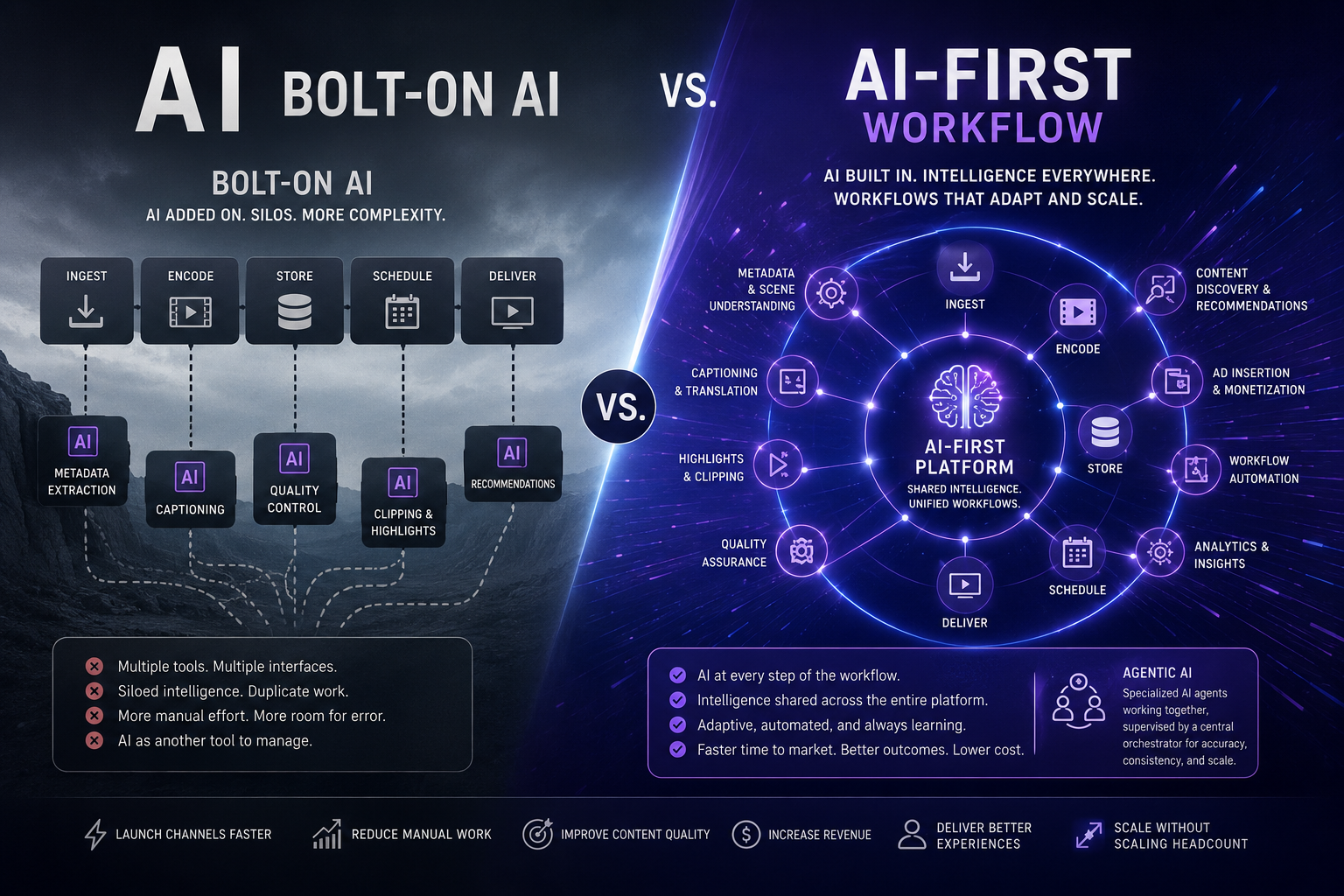
For the past several years, nearly every video technology company has claimed to have “AI.”
Some offer AI-powered metadata.
Others tout AI captioning, AI search, AI scheduling, AI clipping, or AI recommendations.
At first glance, they all sound similar.
They’re not.
The difference comes down to one critical architectural decision:
Was AI designed into the platform from day one—or simply added later?
That distinction may become one of the biggest competitive advantages in modern media operations.
The Bolt-On AI Problem
Many legacy video platforms were built years—even decades—before generative AI existed.
Those platforms were engineered around traditional workflows:
- Ingest
- Encode
- Store
- Schedule
- Deliver
As AI emerged, vendors responded the fastest way possible: they bolted AI capabilities onto existing products.
Need captions? Add another service.
Need metadata? Connect another API.
Need highlights? Integrate another model.
Every new AI capability becomes another point solution with its own interface, configuration, licensing model, and operational overhead.
While this approach adds functionality, it doesn’t fundamentally change how the workflow operates.
Instead, AI becomes another tool that humans must manage.
AI-First Changes Everything
An AI-first platform starts with a very different assumption:
Every piece of content, every workflow, and every operational decision can be enhanced by AI.
Instead of asking,
“Where can we add AI?”
an AI-first platform asks,
“How should AI participate in every step of the workflow?”
That changes everything.
Metadata isn’t generated once.
It evolves continuously.
Scheduling isn’t static.
It adapts automatically based on programming changes, business rules, audience behavior, advertising requirements, and breaking news.
Quality control isn’t a report generated after processing.
It becomes an intelligent system constantly monitoring video, audio, captions, timing, graphics, and delivery—flagging issues or correcting them before viewers ever notice.
Intelligence Becomes Shared Across the Entire Workflow
Perhaps the biggest advantage of AI-first architecture is that intelligence isn’t isolated.
Every workflow benefits from what every other workflow already knows.
Imagine a live sports event.
An AI-first platform doesn’t simply recognize that a goal was scored.
It understands:
- who scored
- when it happened
- which players were involved
- crowd reaction
- announcer excitement
- sponsor relationships
- highlight value
- social media potential
- clipping opportunities
- ad insertion opportunities
- archival metadata
- multilingual caption requirements
Now imagine every downstream system already has access to that intelligence.
Without duplicate processing.
Without exporting files.
Without another AI service.
Without human intervention.
That’s what happens when AI is part of the platform—not attached to it.
Agentic AI Takes It Even Further
The next evolution isn’t simply using larger AI models.
It’s using teams of specialized AI agents.
Rather than asking one model to perform every task, AI-first platforms can deploy specialized agents throughout the workflow.
One agent identifies scenes.
Another extracts metadata.
Another creates captions.
Another prepares vertical video.
Another optimizes advertising.
Another validates quality.
Then a supervisory AI agent reviews the work, checks confidence scores, resolves inconsistencies, and ensures accuracy before content moves downstream.
Think of it as having dozens of highly specialized production assistants, each focused on a single task, with an experienced producer reviewing everything before it goes live.
The result is greater speed, better consistency, and dramatically fewer errors than traditional automation alone.
Why Media Companies Should Care
The media business isn’t getting simpler.
Content volumes continue to grow.
FAST channels are multiplying.
Streaming libraries expand every day.
Sports rights become more fragmented.
Audiences expect clips within seconds.
Advertisers demand better targeting.
Operations teams are expected to do more with fewer people.
These challenges cannot be solved simply by hiring more staff or adding more software.
They require platforms that make intelligent decisions automatically.
Organizations running AI-first workflows can:
- Launch channels faster
- Reduce repetitive manual work
- Improve metadata quality
- Accelerate content repurposing
- Increase advertising opportunities
- Deliver better viewer experiences
- Scale operations without scaling headcount
The productivity gains aren’t incremental—they’re transformational.
This Isn’t About Adding AI
History shows that foundational technology shifts rarely reward incremental thinking.
Companies that added web browsers to desktop software didn’t redefine computing.
Cloud-native companies did.
The same shift is now happening with AI.
Adding AI features to legacy platforms may improve individual tasks.
Building AI into the foundation transforms the entire operating model.
That’s the difference between automation and intelligence.
And it’s why the next generation of media companies won’t simply use AI.
They’ll run on it.