
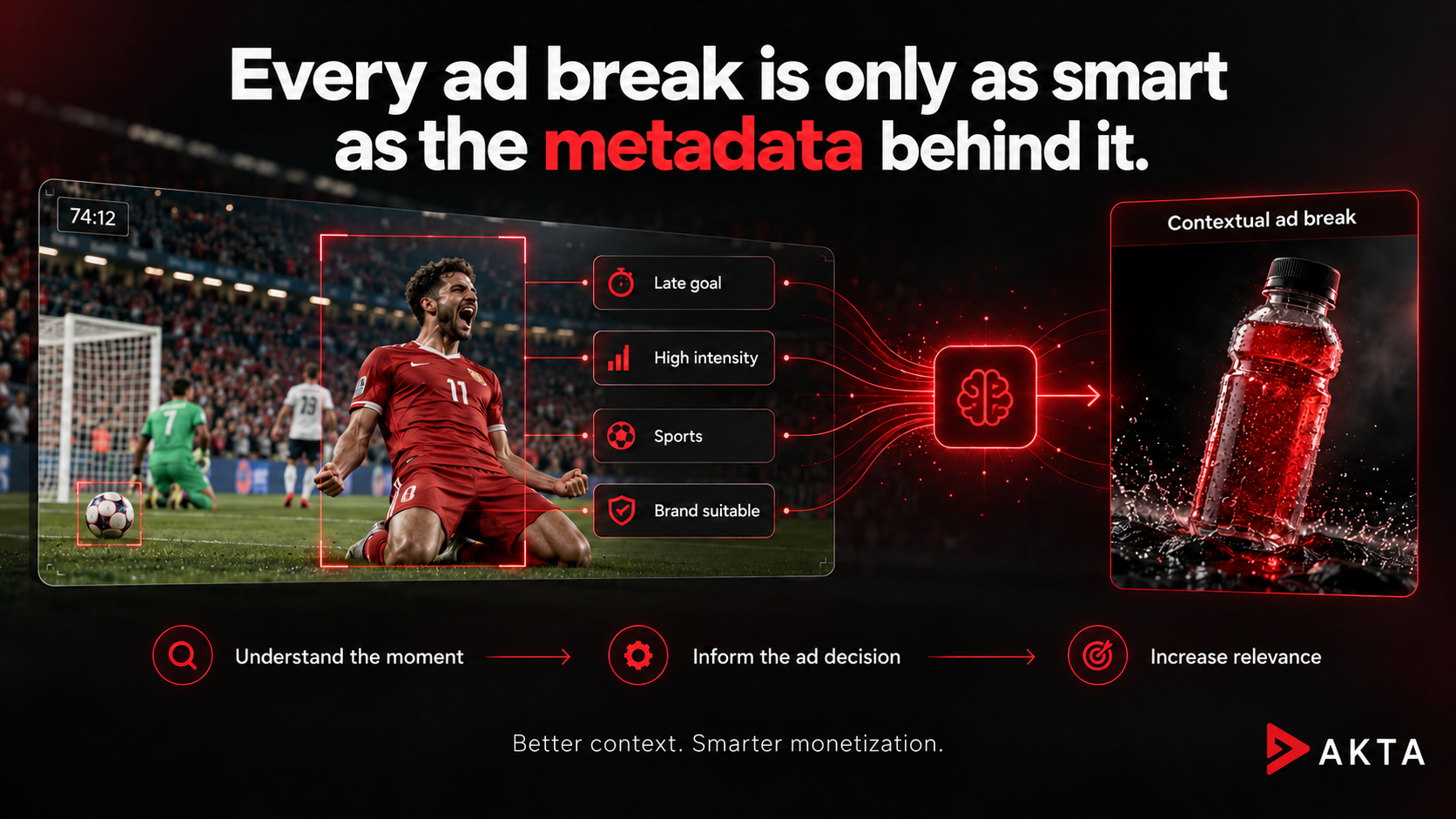
When people think about ad revenue in streaming, they usually think about demand, fill rate and CPMs. Underneath all three is something less glamorous: metadata.
1. How metadata starts. At ingest, most assets arrive knowing very little about themselves. They carry a title, a synopsis, series and episode numbers, a genre and rating, rights windows, technical specs, the EPG slot and SCTE-35 cue markers. That’s useful for operations, but it’s thin. “Sports” tells an ad server almost nothing about what’s actually on screen at minute 74.
2. What AI adds. Video understanding changes the grain of metadata from the asset to the moment. AI can transcribe speech, identify people, objects and logos, find scene boundaries, read sentiment, and flag key events, all in real time. It then maps what it finds to standard taxonomies like IAB content categories and brand-suitability tiers. Humans stay in the loop to review and approve.
3. Why SSAI cares. That context can travel with the stream into every ad decision.
- Place breaks at natural scene changes, not mid-sentence
- Pass key-values like content category, moment, sentiment and on-screen objects with each ad request
- Match brands to context, for example a sports drink after a late goal
- Enforce competitive separation and suitability tiers automatically
- Package high-intensity moments as premium pods
Better context leads to more relevant ads. More relevant ads lead to stronger CPMs. Buyers pay more when they know where their ads will run, and when that environment fits their brand.
At Akta, we believe this is why analysis belongs at ingest, not bolted on at the end. Content gets understood once, and that understanding feeds search, clipping, FAST scheduling and monetization.
What signal would you most want in your ad requests that you don’t have today?