
Every Bit Has a Cost. Not Every Frame Needs the Same Number of Bits.
Video encoding is one of the most important components of the streaming delivery chain. It directly influences picture quality, bandwidth consumption, storage requirements, and the cost of reaching audiences.
For many streaming organizations, encoding has traditionally been treated as a relatively fixed technical process. Video is processed into a predefined set of resolutions and bitrates, packaged for distribution, and delivered through a content delivery network.
This approach works. It can also be unnecessarily expensive.
The fundamental challenge is that video content is not uniform.
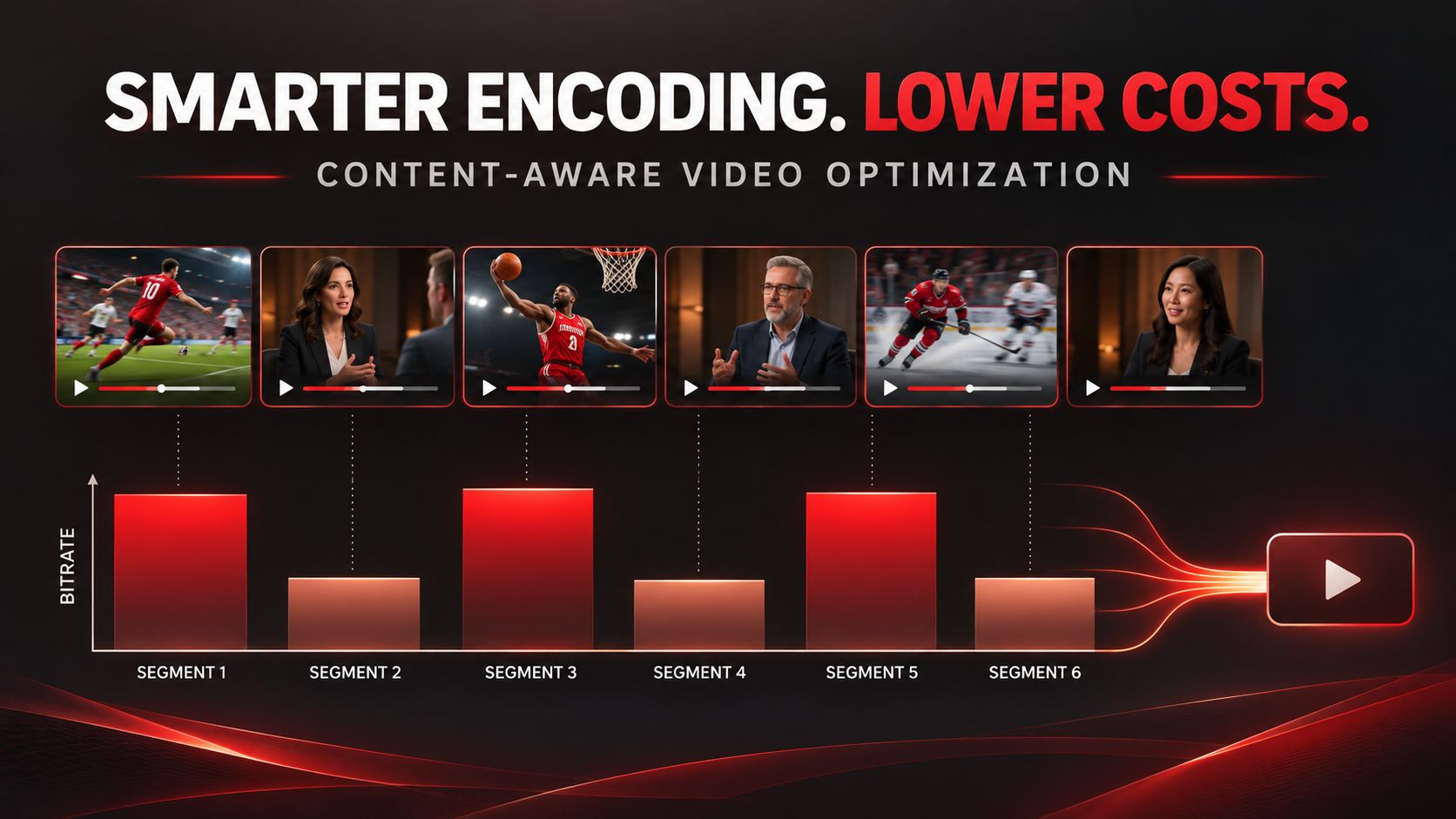
A studio interview featuring two people against a static background requires substantially different encoding resources than a football game with rapid camera movement, detailed crowds, and constantly changing visual information.
Yet conventional encoding profiles frequently allocate similar resources to both.
Akta Enhanced Encoding addresses this inefficiency by making encoding decisions based on the actual content of each video segment.
Understanding the Limitations of Traditional Encoding
Most adaptive bitrate streaming workflows rely on an encoding ladder consisting of multiple representations of the same content.
A typical ladder might include:
- 1080p at 6 Mbps
- 720p at 3 Mbps
- 480p at 1.5 Mbps
- 360p at 800 Kbps
These representations allow the player to adjust video quality based on network conditions, device capabilities, and available bandwidth.
The limitation is that a fixed encoding ladder does not necessarily account for variations in visual complexity within an individual program.
Consider a live sporting event.
A wide stadium shot with thousands of moving spectators places considerable demands on an encoder. A subsequent close-up of a commentator in a relatively static environment requires far fewer bits to maintain comparable visual quality.
Using a fixed bitrate target for both segments can result in bandwidth being allocated where it provides little additional visual benefit.
Across millions of viewing hours, this inefficiency becomes a significant operating expense.
How Akta Enhanced Encoding Works
Akta Enhanced Encoding applies content-aware optimization at the video segment level.
Rather than treating every segment as having equivalent complexity, the platform examines the content and adjusts encoding decisions according to what is happening in-frame.
The process considers characteristics such as:
1. Motion and visual activity
Rapid movement, changing camera angles, and complex action sequences generally require more encoding resources than relatively static scenes.
2. Scene complexity
Highly detailed imagery, textures, backgrounds, and visual transitions influence the amount of information required to preserve picture quality.
3. Segment-specific requirements
Each segment receives encoding parameters suited to its content, allowing the platform to reduce unnecessary data while maintaining visual fidelity.
4. Efficient bandwidth allocation
Encoding resources are concentrated where they provide a meaningful visual benefit. Less demanding segments can be delivered using fewer bits.
The result is a more efficient video stream, with Akta Enhanced Encoding delivering 30–50% bandwidth savings while maintaining visual quality.
The underlying principle is straightforward: encoding decisions should reflect the characteristics of the content, rather than relying exclusively on predetermined bitrate settings.
Why Encoding Efficiency Matters Beyond Bandwidth
Bandwidth reduction is the most immediate benefit. Its impact extends across the video infrastructure.
Lower CDN and delivery costs
For streaming services, data transfer represents a significant recurring operating expense.
Reducing the average bitrate required to deliver equivalent visual quality reduces the amount of data transferred to viewers.
For organizations serving millions of viewing hours each month, the financial impact can be substantial.
Reduced storage requirements
Streaming platforms typically maintain multiple encoded representations of each asset to support different devices, resolutions, and network conditions.
More efficient encoding can reduce the storage footprint of those representations.
For operators managing extensive VOD catalogs, long-form programming, or archived content, lower storage consumption contributes to reduced infrastructure spending.
Greater infrastructure efficiency
Encoding efficiency affects several components of the delivery chain.
Smaller video representations reduce the amount of data that must be stored, transferred, cached, and distributed.
These improvements can help organizations make better use of their existing infrastructure.
More predictable operational costs
As streaming audiences grow, delivery expenses generally increase alongside consumption.
Enhanced Encoding helps reduce the amount of bandwidth required per viewing hour, improving the economics of audience growth.
The Financial Impact: A Practical Example
Consider a streaming service generating 10 million viewing hours per month, with an average delivered bitrate of 5 Mbps.
At that bitrate, the service transfers approximately 22.5 petabytes of video data each month.
Reducing the average bitrate by 40%, while maintaining comparable visual quality, changes the economics considerably.
| Metric | Traditional Encoding | Akta Enhanced Encoding |
|---|---|---|
| Monthly viewing hours | 10 million | 10 million |
| Average delivered bitrate | 5 Mbps | 3 Mbps |
| Monthly video transfer | 22.5 PB | 13.5 PB |
| Monthly bandwidth reduction | — | 9 PB |
| Bandwidth savings | — | 40% |
At an illustrative delivery cost of $0.01 per GB, the reduction in transferred data represents approximately $90,000 in potential monthly delivery savings, or $1.08 million annually.
Actual savings depend on delivery contracts, traffic patterns, encoding profiles, content characteristics, and infrastructure architecture.
This example illustrates how encoding improvements can have a meaningful financial impact without requiring additional audience growth or subscription revenue.
Built for Video Operations Teams of Every Size
Large broadcasters and streaming platforms often manage hundreds of channels, extensive content libraries, and significant concurrent viewership.
Encoding improvements at this scale can reduce millions of dollars in cumulative infrastructure expenditure.
Smaller organizations face a different challenge.
They must deliver professional viewing experiences with limited technical resources and constrained operating budgets.
Content-aware encoding helps both groups address the same fundamental problem: delivering high-quality video without consuming more infrastructure resources than necessary.
For video operations teams, the value extends beyond cost reduction.
Smarter encoding enables existing infrastructure to support more content and viewing activity. It reduces the resources required to distribute video at scale. It also helps organizations manage growth without proportionally increasing their delivery and storage footprint.
An AI-First Approach to Video Infrastructure
Akta’s broader platform philosophy centers on applying intelligence and automation throughout the video workflow.
Encoding is a natural extension of that approach.
Video infrastructure should be capable of adapting to the characteristics of the content it processes.
The same principles that make AI valuable for metadata enrichment, content identification, automated clipping, and intelligent scheduling can inform more efficient media processing.
Enhanced Encoding demonstrates how content-aware processing can produce measurable operational and financial benefits.
It is part of Akta’s broader commitment to helping media organizations reduce manual effort, optimize infrastructure utilization, and improve the economics of video delivery.
Better Video Economics Start at the Encoding Layer
The cost of streaming is influenced by many variables: audience size, video quality, CDN pricing, content libraries, and infrastructure architecture.
Encoding efficiency is one of the areas where technology can directly reduce the resources required to deliver the same viewing experience.
Akta Enhanced Encoding achieves this by examining individual video segments and applying encoding decisions appropriate to their visual complexity.
The outcome is 30–50% less bandwidth consumption, reduced storage requirements, and maintained visual quality.
For broadcasters, OTT platforms, FAST channel operators, and digital media organizations, these improvements help make video operations more sustainable at scale.
Better encoding is not simply about reducing bitrate. It is about using the right amount of data to deliver the right visual experience.